
Publications
Volumetric Inverse Rendering via Neural Radiative Transfer
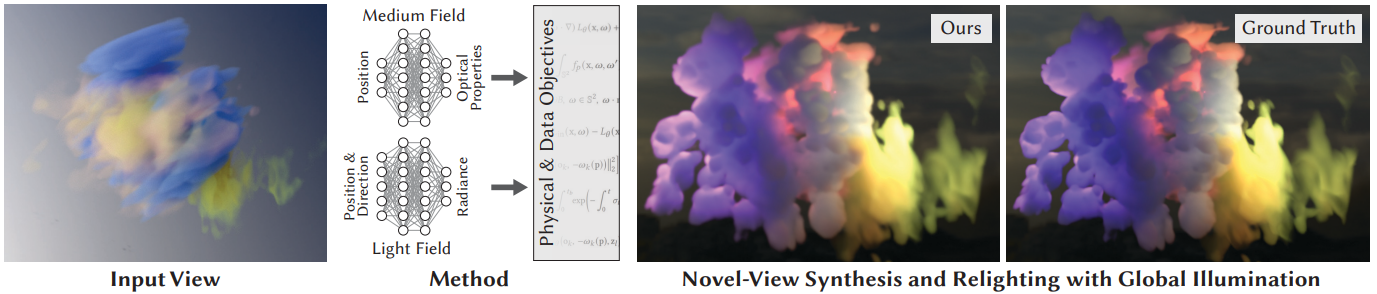
Volumetric inverse rendering seeks to recover the optical properties of participating media from images. Existing approaches either rely on differentiable stochastic light transport simulation, which require substantial algorithmic effort, or use simplified models that fail to capture global illumination. We propose a formulation that reconciles physically complete light transport with general-purpose neural optimization. The optical properties of the medium and the full light field are represented as neural fields and estimated through a joint optimization process. Global illumination is enforced via a residual objective derived from the Radiative Transfer Equation in local differential form, complemented by a volume rendering term along primary viewing rays to mitigate \rev{low-frequency} bias. We demonstrate reconstruction of spatially varying, color-resolved scattering, absorption, and phase function parameters from multi-view images. Beyond reconstruction, the same framework supports learning generative models of participating media with physical optical properties under global illumination.
Best Paper Award
Faster 3D Gaussian Splatting Convergence via Structure-Aware Densification

3D Gaussian Splatting has emerged as a powerful scene representation for real-time novel-view synthesis. However, its standard adaptive density control relies on screen-space positional gradients, which do not distinguish between geometric misplacement and frequency aliasing, often leading to either over-blurred high-frequency textures or inefficient over-densification. We present a structure-aware densification framework. The key insight is that the decision to subdivide a Gaussian should be driven by an explicit comparison between its projected screen-space extent and the local structure of the texture it seeks to represent. We introduce a multi-scale frequency analysis combining structure tensors with Laplacian scale space analysis to estimate dominant local frequency, define a per-Gaussian, per-axis frequency violation metric, and perform anisotropic splitting with a multiview consistency criterion. By densifying early and more directly, the method skips lengthy iterative densification phases and achieves faster convergence with superior reconstruction quality, particularly in high-frequency regions.
Splat the Net: Radiance Fields with Splattable Neural Primitives

Radiance fields have emerged as a predominant representation for modeling 3D scene appearance. Neural formulations such as Neural Radiance Fields provide high expressivity but require costly ray marching for rendering, whereas primitive- based methods such as 3D Gaussian Splatting offer real-time efficiency through splatting, yet at the expense of representational power. Inspired by advances in both these directions, we introduce splattable neural primitives, a new volumetric representation that reconciles the expressivity of neural models with the efficiency of primitive-based splatting. Each primitive encodes a bounded neural density field parameterized by a shallow neural network. Our formulation admits an exact analytical solution for line integrals, enabling efficient computation of perspectively accurate splatting kernels. As a result, our representation supports integration along view rays without the need for costly ray marching. The primitives flexibly adapt to scene geometry and, being larger than prior analytic primitives, reduce the number required per scene. On novel-view synthesis benchmarks, our approach matches the quality and speed of 3D Gaussian Splatting while using 10× fewer primitives and 6× fewer parameters. These advantages arise directly from the representation itself, without reliance on complex control or adaptation frameworks.
Appearance Meets Geometry: Deep Learning for Semantic Segmentation of Archaeological Fortification Masonry
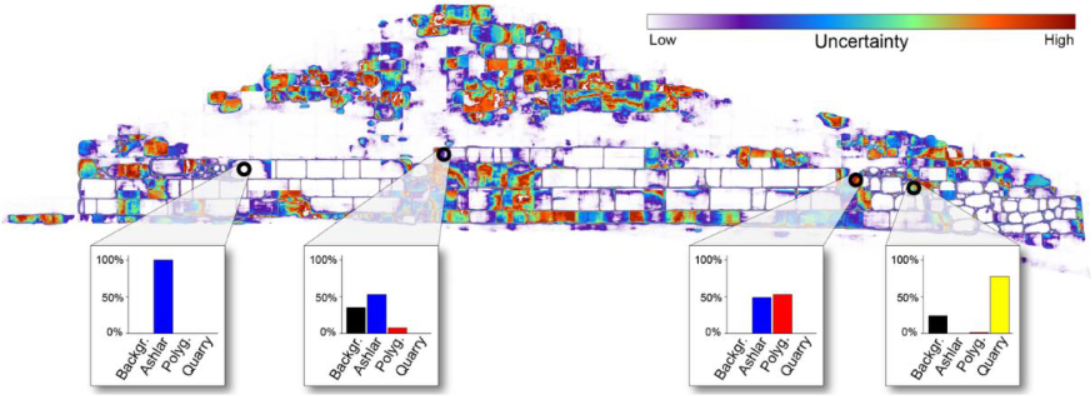
Modern archaeological practice faces a critical bottleneck: while photogrammetric surveys routinely generate terabytes of high-resolution 3D data from ancient fortifications, manual interpretation methods remain time-consuming and subjective, leaving much documentation underexploited. This paper presents a novel machine-learning workflow that bridges the gap between high-throughput data acquisition and efficient analysis by leveraging both appearance and geometric information from 3D photogrammetric models for automated masonry semantic segmentation. Our approach transforms 3D documentation into a dual-layer format combining high-resolution orthomosaics with geometry-based normal maps derived from heightmap data. We trained convolutional neural networks on annotated datasets from Carian fortification walls currently spanning approximately 700 m across the ancient sites of Halicarnassus and Cedreae. The training dataset comprises 1,876 m² of wall facade with 5,560 individually annotated stones across several masonry classes. Comparative evaluation of appearance-only, geometry-only, and combined models shows consistent performance advantages for the integrated approach. In an ensemble evaluation over five independent training runs per variant, the combined model improved mean stone IoU by 10% over the geometry-only and 4% over the appearance-only model, with this ordering consistent across all individual runs. These results confirm that visual and geometric features provide complementary information essential for robust archaeological analysis. The automated approach enables processing of kilometer-long fortifications in minutes of computation, compared to the weeks of manual drawing and classification that traditional methods require. This transforms archaeological documentation from selective sampling to comprehensive analysis of entire defensive systems. This work represents a concrete step toward realizing photogrammetry's analytical potential, enabling systematic comparative studies across sites and periods at unprecedented scales.
Previous Year (2025)
