
Welcome


Our research and teaching activities revolve around computational representations of the visual world, at the intersection of computer graphics, computer vision, signal processing, and machine learning. How can we efficiently represent visual information using both physics-based and data-driven approaches? How can we model the interaction of light with the world to understand the relationship between physical reality and visual observations? How can we incorporate prior knowledge, such as generative AI, to reason about incomplete or ambiguous visual observations? And how can we leverage visual representations to synthesize, analyze, and explore visual content?
News
| • |
We are looking for motivated PhD students to join the Visual Representations group as part of the ERC Starting Grant project MonuMicro. If you are interested, please get in touch! |
Oct. 9, 2026 |
| • |
Thomas Leimkühler has established the new Visual Representations research group at the Visual Computing Institute of RWTH Aachen University. |
Oct. 8, 2026 |
Recent Publications
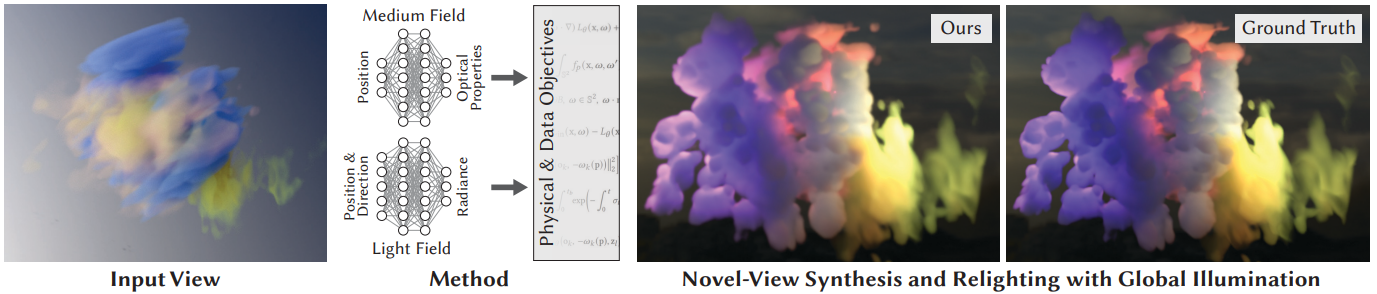 Volumetric Inverse Rendering via Neural Radiative Transfer Computer Graphics Forum (EGSR 2026) Volumetric inverse rendering seeks to recover the optical properties of participating media from images. Existing approaches either rely on differentiable stochastic light transport simulation, which require substantial algorithmic effort, or use simplified models that fail to capture global illumination. We propose a formulation that reconciles physically complete light transport with general-purpose neural optimization. The optical properties of the medium and the full light field are represented as neural fields and estimated through a joint optimization process. Global illumination is enforced via a residual objective derived from the Radiative Transfer Equation in local differential form, complemented by a volume rendering term along primary viewing rays to mitigate \rev{low-frequency} bias. We demonstrate reconstruction of spatially varying, color-resolved scattering, absorption, and phase function parameters from multi-view images. Beyond reconstruction, the same framework supports learning generative models of participating media with physical optical properties under global illumination. 
|
 Faster 3D Gaussian Splatting Convergence via Structure-Aware Densification SIGGRAPH 2026 3D Gaussian Splatting has emerged as a powerful scene representation for real-time novel-view synthesis. However, its standard adaptive density control relies on screen-space positional gradients, which do not distinguish between geometric misplacement and frequency aliasing, often leading to either over-blurred high-frequency textures or inefficient over-densification. We present a structure-aware densification framework. The key insight is that the decision to subdivide a Gaussian should be driven by an explicit comparison between its projected screen-space extent and the local structure of the texture it seeks to represent. We introduce a multi-scale frequency analysis combining structure tensors with Laplacian scale space analysis to estimate dominant local frequency, define a per-Gaussian, per-axis frequency violation metric, and perform anisotropic splitting with a multiview consistency criterion. By densifying early and more directly, the method skips lengthy iterative densification phases and achieves faster convergence with superior reconstruction quality, particularly in high-frequency regions.
|
 Splat the Net: Radiance Fields with Splattable Neural Primitives ICLR 2026 Radiance fields have emerged as a predominant representation for modeling 3D scene appearance. Neural formulations such as Neural Radiance Fields provide high expressivity but require costly ray marching for rendering, whereas primitive- based methods such as 3D Gaussian Splatting offer real-time efficiency through splatting, yet at the expense of representational power. Inspired by advances in both these directions, we introduce splattable neural primitives, a new volumetric representation that reconciles the expressivity of neural models with the efficiency of primitive-based splatting. Each primitive encodes a bounded neural density field parameterized by a shallow neural network. Our formulation admits an exact analytical solution for line integrals, enabling efficient computation of perspectively accurate splatting kernels. As a result, our representation supports integration along view rays without the need for costly ray marching. The primitives flexibly adapt to scene geometry and, being larger than prior analytic primitives, reduce the number required per scene. On novel-view synthesis benchmarks, our approach matches the quality and speed of 3D Gaussian Splatting while using 10× fewer primitives and 6× fewer parameters. These advantages arise directly from the representation itself, without reliance on complex control or adaptation frameworks.
|
