
Profile

|
Prof. Dr. Thomas Leimkühler |
Publications
Volumetric Inverse Rendering via Neural Radiative Transfer
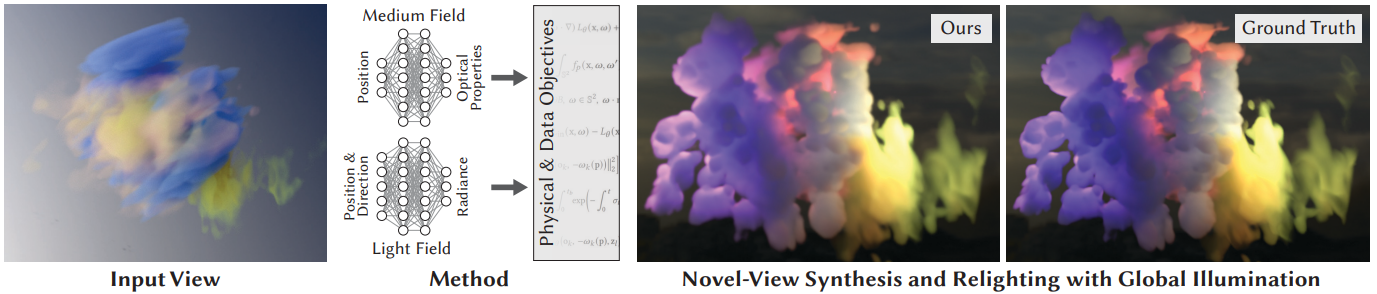
Volumetric inverse rendering seeks to recover the optical properties of participating media from images. Existing approaches either rely on differentiable stochastic light transport simulation, which require substantial algorithmic effort, or use simplified models that fail to capture global illumination. We propose a formulation that reconciles physically complete light transport with general-purpose neural optimization. The optical properties of the medium and the full light field are represented as neural fields and estimated through a joint optimization process. Global illumination is enforced via a residual objective derived from the Radiative Transfer Equation in local differential form, complemented by a volume rendering term along primary viewing rays to mitigate \rev{low-frequency} bias. We demonstrate reconstruction of spatially varying, color-resolved scattering, absorption, and phase function parameters from multi-view images. Beyond reconstruction, the same framework supports learning generative models of participating media with physical optical properties under global illumination.
Best Paper Award
Faster 3D Gaussian Splatting Convergence via Structure-Aware Densification

3D Gaussian Splatting has emerged as a powerful scene representation for real-time novel-view synthesis. However, its standard adaptive density control relies on screen-space positional gradients, which do not distinguish between geometric misplacement and frequency aliasing, often leading to either over-blurred high-frequency textures or inefficient over-densification. We present a structure-aware densification framework. The key insight is that the decision to subdivide a Gaussian should be driven by an explicit comparison between its projected screen-space extent and the local structure of the texture it seeks to represent. We introduce a multi-scale frequency analysis combining structure tensors with Laplacian scale space analysis to estimate dominant local frequency, define a per-Gaussian, per-axis frequency violation metric, and perform anisotropic splitting with a multiview consistency criterion. By densifying early and more directly, the method skips lengthy iterative densification phases and achieves faster convergence with superior reconstruction quality, particularly in high-frequency regions.
Splat the Net: Radiance Fields with Splattable Neural Primitives

Radiance fields have emerged as a predominant representation for modeling 3D scene appearance. Neural formulations such as Neural Radiance Fields provide high expressivity but require costly ray marching for rendering, whereas primitive- based methods such as 3D Gaussian Splatting offer real-time efficiency through splatting, yet at the expense of representational power. Inspired by advances in both these directions, we introduce splattable neural primitives, a new volumetric representation that reconciles the expressivity of neural models with the efficiency of primitive-based splatting. Each primitive encodes a bounded neural density field parameterized by a shallow neural network. Our formulation admits an exact analytical solution for line integrals, enabling efficient computation of perspectively accurate splatting kernels. As a result, our representation supports integration along view rays without the need for costly ray marching. The primitives flexibly adapt to scene geometry and, being larger than prior analytic primitives, reduce the number required per scene. On novel-view synthesis benchmarks, our approach matches the quality and speed of 3D Gaussian Splatting while using 10× fewer primitives and 6× fewer parameters. These advantages arise directly from the representation itself, without reliance on complex control or adaptation frameworks.
Appearance Meets Geometry: Deep Learning for Semantic Segmentation of Archaeological Fortification Masonry
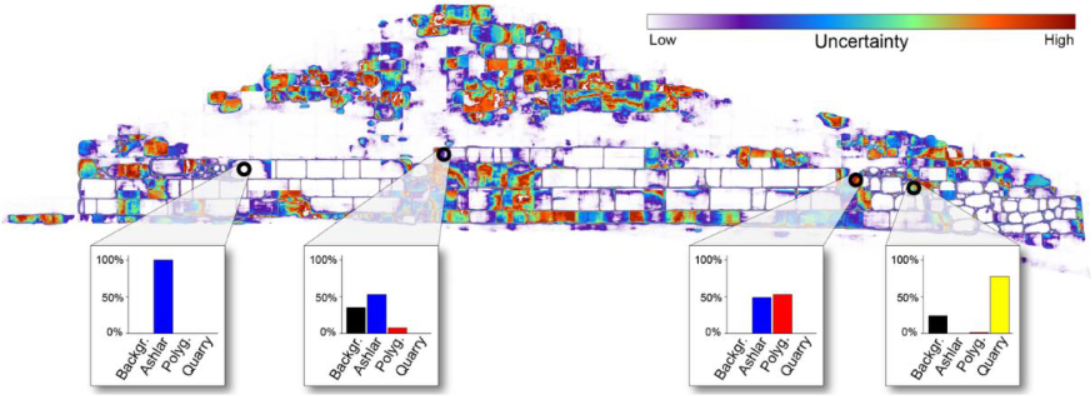
Modern archaeological practice faces a critical bottleneck: while photogrammetric surveys routinely generate terabytes of high-resolution 3D data from ancient fortifications, manual interpretation methods remain time-consuming and subjective, leaving much documentation underexploited. This paper presents a novel machine-learning workflow that bridges the gap between high-throughput data acquisition and efficient analysis by leveraging both appearance and geometric information from 3D photogrammetric models for automated masonry semantic segmentation. Our approach transforms 3D documentation into a dual-layer format combining high-resolution orthomosaics with geometry-based normal maps derived from heightmap data. We trained convolutional neural networks on annotated datasets from Carian fortification walls currently spanning approximately 700 m across the ancient sites of Halicarnassus and Cedreae. The training dataset comprises 1,876 m² of wall facade with 5,560 individually annotated stones across several masonry classes. Comparative evaluation of appearance-only, geometry-only, and combined models shows consistent performance advantages for the integrated approach. In an ensemble evaluation over five independent training runs per variant, the combined model improved mean stone IoU by 10% over the geometry-only and 4% over the appearance-only model, with this ordering consistent across all individual runs. These results confirm that visual and geometric features provide complementary information essential for robust archaeological analysis. The automated approach enables processing of kilometer-long fortifications in minutes of computation, compared to the weeks of manual drawing and classification that traditional methods require. This transforms archaeological documentation from selective sampling to comprehensive analysis of entire defensive systems. This work represents a concrete step toward realizing photogrammetry's analytical potential, enabling systematic comparative studies across sites and periods at unprecedented scales.
IntrinsicEdit: Precise generative image manipulation in intrinsic space

Generative diffusion models have advanced image editing with high-quality results and intuitive interfaces such as prompts and semantic drawing. However, these interfaces lack precise control, and the associated methods typically specialize on a single editing task. We introduce a versatile, generative workflow that operates in an intrinsic-image latent space, enabling semantic, local manipulation with pixel precision for a range of editing operations. Building atop the RGB-X diffusion framework, we address key challenges of identity preservation and intrinsic-channel entanglement. By incorporating exact diffusion inversion and disentangled channel manipulation, we enable precise, efficient editing with automatic resolution of global illumination effects -- all without additional data collection or model fine-tuning. We demonstrate state-of-the-art performance across a variety of tasks on complex images, including color and texture adjustments, object insertion and removal, global relighting, and their combinations.
Marching Neurons: Accurate Surface Extraction for Neural Implicit Shapes

Accurate surface geometry representation is crucial in 3D visual computing. Explicit representations, such as polygonal meshes, and implicit representations, like signed distance functions, each have distinct advantages, making efficient conversions between them increasingly important. Conventional surface extraction methods for implicit representations, such as the widely used Marching Cubes algorithm, rely on spatial decomposition and sampling, leading to inaccuracies due to fixed and limited resolution. We introduce a novel approach for analytically extracting surfaces from neural implicit functions. Our method operates natively in parallel and can navigate large neural architectures. By leveraging the fact that each neuron partitions the domain, we develop a depth-first traversal strategy to efficiently track the encoded surface. The resulting meshes faithfully capture the full geometric information from the network without ad-hoc spatial discretization, achieving unprecedented accuracy across diverse shapes and network architectures while maintaining competitive speed.
Bracket Diffusion: HDR Image Generation by Consistent LDR Denoising

We demonstrate generating HDR images using the concerted action of multiple black-box, pre-trained LDR image diffusion models. Relying on a pre-trained LDR generative diffusion models is vital as, first, there is no sufficiently large HDR image dataset available to re-train them, and, second, even if it was, re-training such models is impossible for most compute budgets. Instead, we seek inspiration from the HDR image capture literature that traditionally fuses sets of LDR images, called "exposure brackets'', to produce a single HDR image. We operate multiple denoising processes to generate multiple LDR brackets that together form a valid HDR result. The key to making this work is to introduce a consistency term into the diffusion process to couple the brackets such that they agree across the exposure range they share while accounting for possible differences due to the quantization error. We demonstrate state-of-the-art unconditional and conditional or restoration-type (LDR2HDR) generative modeling results, yet in HDR.
Learning Image Fractals Using Chaotic Differentiable Point Splatting

Fractal geometry, defined by self-similar patterns across scales, is crucial for understanding natural structures. This work addresses the fractal inverse problem, which involves extracting fractal codes from images to explain these patterns and synthesize them at arbitrary finer scales. We introduce a novel algorithm that optimizes Iterated Function System parameters using a custom fractal generator combined with differentiable point splatting. By integrating both stochastic and gradient-based optimization techniques, our approach effectively navigates the complex energy landscapes typical of fractal inversion, ensuring robust performance and the ability to escape local minima. We demonstrate the method’s effectiveness through comparisons with various fractal inversion techniques, highlighting its ability to recover high-quality fractal codes and perform extensive zoom-ins to reveal intricate patterns from just a single image.
LEDiff: Latent Exposure Diffusion for HDR Generation

While consumer displays increasingly support more than 10 stops of dynamic range, most image assets — such as internet photographs and generative AI content — remain limited to 8-bit low dynamic range (LDR), constraining their utility across high dynamic range (HDR) applications. Currently, no generative model can produce high-bit, high-dynamic range content in a generalizable way. Existing LDR-to-HDR conversion methods often struggle to produce photorealistic details and physically-plausible dynamic range in the clipped areas. We introduce LEDiff, a method that enables a generative model with HDR content generation through latent space fusion inspired by image-space exposure fusion techniques. It also functions as an LDR-to-HDR converter, expanding the dynamic range of existing low-dynamic range images.
Learning Neural Antiderivatives

Neural fields offer continuous, learnable representations that extend beyond traditional discrete formats in visual computing. We study the problem of learning neural representations of repeated antiderivatives directly from a function, a continuous analogue of summed-area tables. Although widely used in discrete domains, such cumulative schemes rely on grids, which prevents their applicability in continuous neural contexts. We introduce and analyze a range of neural methods for repeated integration, including both adaptations of prior work and novel designs. Our evaluation spans multiple input dimensionalities and integration orders, assessing both reconstruction quality and performance in downstream tasks such as filtering and rendering. These results enable integrating classical cumulative operators into modern neural systems and offer insights into learning tasks involving differential and integral operators.
Neural Gaussian Scale-Space Fields

Gaussian scale spaces are a cornerstone of signal representation and processing, with applications in filtering, multiscale analysis, anti-aliasing, and many more. However, obtaining such a scale space is costly and cumbersome, in particular for continuous representations such as neural fields. We present an efficient and lightweight method to learn the fully continuous, anisotropic Gaussian scale space of an arbitrary signal. Based on Fourier feature modulation and Lipschitz bounding, our approach is trained self-supervised, i.e., training does not require any manual filtering. Our neural Gaussian scale-space fields faithfully capture multiscale representations across a broad range of modalities, and support a diverse set of applications. These include images, geometry, light-stage data, texture anti-aliasing, and multiscale optimization.
Learning Images Across Scales Using Adversarial Training

The real world exhibits rich structure and detail across many scales of observation. It is difficult, however, to capture and represent a broad spectrum of scales using ordinary images. We devise a novel paradigm for learning a representation that captures an orders-of-magnitude variety of scales from an unstructured collection of ordinary images. We treat this collection as a distribution of scale-space slices to be learned using adversarial training, and additionally enforce coherency across slices. Our approach relies on a multiscale generator with carefully injected procedural frequency content, which allows to interactively explore the emerging continuous scale space. Training across vastly different scales poses challenges regarding stability, which we tackle using a supervision scheme that involves careful sampling of scales. We show that our generator can be used as a multiscale generative model, and for reconstructions of scale spaces from unstructured patches. Significantly outperforming the state of the art, we demonstrate zoom-in factors of up to 256x at high quality and scale consistency.
Manifold Sampling for Differentiable Uncertainty in Radiance Fields

Radiance fields are powerful and, hence, popular models for representing the appearance of complex scenes. Yet, constructing them based on image observations gives rise to ambiguities and uncertainties. We propose a versatile approach for learning Gaussian radiance fields with explicit and fine-grained uncertainty estimates that impose only little additional cost compared to uncertainty-agnostic training. Our key observation is that uncertainties can be modeled as a low-dimensional manifold in the space of radiance field parameters that is highly amenable to Monte Carlo sampling. Importantly, our uncertainties are differentiable and, thus, allow for gradient-based optimization of subsequent captures that optimally reduce ambiguities. We demonstrate state-of-the-art performance on next-best-view planning tasks, including high-dimensional illumination planning for optimal radiance field relighting quality.
Physically-Based Lighting for 3D Generative Models of Cars

Recent work has demonstrated that Generative Adversarial Networks (GANs) can be trained to generate 3D content from 2D image collections, by synthesizing features for neural radiance field rendering. However, most such solutions generate radiance, with lighting entangled with materials. This results in unrealistic appearance, since lighting cannot be changed and view-dependent effects such as reflections do not move correctly with the viewpoint. In addition, many methods have difficulty for full, 360◦ rotations, since they are often designed for mainly front-facing scenes such as faces. We introduce a new 3D GAN framework that addresses these shortcomings, allowing multi-view coherent 360◦ viewing and at the same time relighting for objects with shiny reflections, which we exemplify using a car dataset. The success of our solution stems from three main contributions. First, we estimate initial camera poses for a dataset of car images, and then learn to refine the distribution of camera parameters while training the GAN. Second, we propose an efficient Image-Based Lighting model, that we use in a 3D GAN to generate disentangled reflectance, as opposed to the radiance synthesized in most previous work. The material is used for physically-based rendering with a dataset of environment maps. Third, we improve the 3D GAN architecture compared to previous work and design a careful training strategy that allows effective disentanglement. Our model is the first that generatea variety of 3D cars that are multi-view consistent and that can be relit interactively with any environment map.
Who Did It? How User Agency is Influenced by Visual Properties of Generated Images

The increasing proliferation of AI and GenAI requires new interfaces tailored to how their specific affordances and human requirements meet. As GenAI is capable of taking over tasks from users on an unprecedented scale, designing the experience of agency – if and how users experience control over the process and attribution of the outcome – is crucial. As an initial step towards design guidelines for shaping agency, we present a study that explores how properties of AI-generated images influence users’ experience of agency. We use two measures; temporal binding to implicitly estimate pre-reflective agency and magnitude estimation to assess user judgments of agency. We observe that abstract images lead to more temporal binding than images with semantic meaning. In contrast, the closer an image aligns with what a user might expect, the higher the agency judgment. When comparing the experiment results with objective metrics of image differences, we find that temporal binding results correlate with semantic differences, while agency judgments are better explained by local differences between images. This work contributes towards a future where agency is considered an important design dimension for GenAI interfaces.
Cinematic Gaussians: Real-Time HDR Radiance Fields with Depth of Field

Radiance field methods represent the state of the art in reconstructing complex scenes from multi-view photos. However, these reconstructions often suffer from one or both of the following limitations: First, they typically represent scenes in low dynamic range (LDR), which restricts their use to evenly lit environments and hinders immersive viewing experiences. Secondly, their reliance on a pinhole camera model, assuming all scene elements are in focus in the input images, presents practical challenges and complicates refocusing during novel-view synthesis. Addressing these limitations, we present a lightweight method based on 3D Gaussian Splatting that utilizes multi-view LDR images of a scene with varying exposure times, apertures, and focus distances as input to reconstruct a high-dynamic-range (HDR) radiance field. By incorporating analytical convolutions of Gaussians based on a thin-lens camera model as well as a tonemapping module, our reconstructions enable the rendering of HDR content with flexible refocusing capabilities. We demonstrate that our combined treatment of HDR and depth of field facilitates real-time cinematic rendering, outperforming the state of the art.
ROAM: Robust and Object-aware Motion Generation using Neural Pose Descriptors

Existing automatic approaches for 3D virtual character motion synthesis supporting scene interactions do not generalise well to new objects outside training distributions, even when trained on extensive motion capture datasets with diverse objects and annotated interactions. This paper addresses this limitation and shows that robustness and generalisation to novel scene objects in 3D object-aware character synthesis can be achieved by training a motion model with as few as one reference object. We leverage an implicit feature representation trained on object-only datasets, which encodes an SE(3)-equivariant descriptor field around the object. Given an unseen object and a reference pose-object pair, we optimise for the object-aware pose that is closest in the feature space to the reference pose. Finally, we use l-NSM, i.e., our motion generation model that is trained to seamlessly transition from locomotion to object interaction with the proposed bidirectional pose blending scheme. Through comprehensive numerical comparisons to state-of-the-art methods and in a user study, we demonstrate substantial improvements in 3D virtual character motion and interaction quality and robustness to scenarios with unseen objects.
3D Gaussian Splatting for Real-Time Radiance Field Rendering

Radiance Field methods have recently revolutionized novel-view synthesis of scenes captured with multiple photos or videos. However, achieving high visual quality still requires neural networks that are costly to train and render, while recent faster methods inevitably trade off speed for quality. For unbounded and complete scenes (rather than isolated objects) and 1080p resolution rendering, no current method can achieve real-time display rates. We introduce three key elements that allow us to achieve state-of-the-art visual quality while maintaining competitive training times and importantly allow high-quality real-time (≥ 100 fps) novel-view synthesis at 1080p resolution. First, starting from sparse points produced during camera calibration, we represent the scene with 3D Gaussians that preserve desirable properties of continuous volumetric radiance fields for scene optimization while avoiding unnecessary computation in empty space; Second, we perform interleaved optimization/density control of the 3D Gaussians, notably optimizing anisotropic covariance to achieve an accurate representation of the scene; Third, we develop a fast visibility-aware rendering algorithm that supports anisotropic splatting and both accelerates training and allows realtime rendering. We demonstrate state-of-the-art visual quality and real-time rendering on several established datasets.
Best Paper Award, Frontiers of Science Award
Drag Your GAN: Interactive Point-based Manipulation on the Generative Image Manifold

Synthesizing visual content that meets users' needs often requires flexible and precise controllability of the pose, shape, expression, and layout of the generated objects. Existing approaches gain controllability of generative adversarial networks (GANs) via manually annotated training data or a prior 3D model, which often lack flexibility, precision, and generality. In this work, we study a powerful yet much less explored way of controlling GANs, that is, to "drag" any points of the image to precisely reach target points in a user-interactive manner, as shown in Fig.1. To achieve this, we propose DragGAN, which consists of two main components including: 1) a feature-based motion supervision that drives the handle point to move towards the target position, and 2) a new point tracking approach that leverages the discriminative GAN features to keep localizing the position of the handle points. Through DragGAN, anyone can deform an image with precise control over where pixels go, thus manipulating the pose, shape, expression, and layout of diverse categories such as animals, cars, humans, landscapes, etc. As these manipulations are performed on the learned generative image manifold of a GAN, they tend to produce realistic outputs even for challenging scenarios such as hallucinating occluded content and deforming shapes that consistently follow the object's rigidity. Both qualitative and quantitative comparisons demonstrate the advantage of DragGAN over prior approaches in the tasks of image manipulation and point tracking. We also showcase the manipulation of real images through GAN inversion.
Neural Field Convolutions by Repeated Differentiation

Neural fields are evolving towards a general-purpose continuous representation for visual computing. Yet, despite their numerous appealing properties, they are hardly amenable to signal processing. As a remedy, we present a method to perform general continuous convolutions with general continuous signals such as neural fields. Observing that piecewise polynomial kernels reduce to a sparse set of Dirac deltas after repeated differentiation, we leverage convolution identities and train a repeated integral field to efficiently execute large-scale convolutions. We demonstrate our approach on a variety of data modalities and spatially-varying kernels.
Diffusion Posterior Illumination for Ambiguity-aware Inverse Rendering

Inverse rendering, the process of inferring scene properties from images, is a challenging inverse problem.The task is ill-posed, as many different scene configurations can give rise to the same image. Most existing solutions incorporate priors into the inverse-rendering pipeline to encourage plausible solutions, but they do not consider the inherent ambiguities and the multi-modal distribution of possible decompositions.In this work, we propose a novel scheme that integrates a denoising diffusion probabilistic model pre-trained on natural illumination maps into an optimization framework involving a differentiable path tracer. The proposed method allows sampling from combinations of illumination and spatially-varying surface materials that are, both, natural and explain the image observations. We further conduct an extensive comparative study of different priors on illumination used in previous work on inverse rendering.Our method excels in recovering materials and producing highly realistic and diverse environment map samples that faithfully explain the illumination of the input images.
An Implicit Neural Representation for the Image Stack: Depth, All in Focus, and High Dynamic Range

n everyday photography, physical limitations of camera sensors and lenses frequently lead to a variety of degradations in captured images such as saturation or defocus blur. A common approach to overcome these limitations is to resort to image stack fusion, which involves capturing multiple images with different focal distances or exposures. For instance, to obtain an all-in-focus image, a set of multi-focus images is captured. Similarly, capturing multiple exposures allows for the reconstruction of high dynamic range. In this paper, we present a novel approach that combines neural fields with an expressive camera model to achieve a unified reconstruction of an all-in-focus high-dynamic-range image from an image stack. Our approach is composed of a set of specialized implicit neural representations tailored to address specific sub-problems along our pipeline: We use neural implicits to predict flow to overcome misalignments arising from lens breathing, depth, and all-in-focus images to account for depth of field, as well as tonemapping to deal with sensor responses and saturation -- all trained using a physically inspired supervision structure with a differentiable thin lens model at its core. An important benefit of our approach is its ability to handle these tasks simultaneously or independently, providing flexible post-editing capabilities such as refocusing and exposure adjustment. By sampling the three primary factors in photography within our framework (focal distance, aperture, and exposure time), we conduct a thorough exploration to gain valuable insights into their significance and impact on overall reconstruction quality. Through extensive validation, we demonstrate that our method outperforms existing approaches in both depth-from-defocus and all-in-focus image reconstruction tasks. Moreover, our approach exhibits promising results in each of these three dimensions, showcasing its potential to enhance captured image quality and provide greater control in post-processing.
GlowGAN: Unsupervised Learning of HDR Images from LDR Images in the Wild

Most in-the-wild images are stored in Low Dynamic Range (LDR) form, serving as a partial observation of the High Dynamic Range (HDR) visual world.Despite limited dynamic range, these LDR images are often captured with different exposures, implicitly containing information about the underlying HDR image distribution.Inspired by this intuition, in this work we present, to the best of our knowledge, the first method for learning a generative model of HDR images from in-the-wild LDR image collections in a fully unsupervised manner. The key idea is to train a generative adversarial network (GAN) to generate HDR images which, when projected to LDR under various exposures, are indistinguishable from real LDR images.The projection from HDR to LDR is achieved via a camera model that captures the stochasticity in exposure and camera response function.Experiments show that our method GlowGAN can synthesize photorealistic HDR images in many challenging cases such as landscapes, lightning, or windows, where previous supervised generative models produce overexposed images. With the assistance of GlowGAN, we showcase the novel application of unsupervised inverse tone mapping (GlowGAN-ITM) that sets a new paradigm in this field. Unlike previous methods that gradually complete information from LDR input, GlowGAN-ITM searches the entire HDR image manifold modeled by GlowGAN for the HDR images which can be mapped back to the LDR input. GlowGAN-ITM achieves more realistic reconstruction of overexposed regions compared to state-of-the-art supervised learning models, despite not requiring HDR images or paired multi-exposure images for training.
NeRFshop: Interactive Editing of Neural Radiance Fields

Neural Radiance Fields (NeRFs) have revolutionized novel view synthesis for captured scenes, with recent methods allowing interactive free-viewpoint navigation and fast training for scene reconstruction. However, the implicit representations used by these methods — often including neural networks and complex encodings — make them difficult to edit. Some initial methods have been proposed, but they suffer from limited editing capabilities and/or from a lack of interactivity, and are thus unsuitable for interactive editing of captured scenes. We tackle both limitations and introduce NeRFshop, a novel end-to-end method that allows users to interactively select and deform objects through cage-based transformations. NeRFshop provides fine scribble-based user control for the selection of regions or objects to edit, semi-automatic cage creation, and interactive volumetric manipulation of scene content thanks to our GPU-friendly two-level interpolation scheme. Further, we introduce a preliminary approach that reduces potential resulting artifacts of these transformations with a volumetric membrane interpolation technique inspired by Poisson image editing and provide a process that "distills" the edits into a standalone NeRF representation.
Neural Point Catacaustics for Novel-View Synthesis of Reflections

View-dependent effects such as reflections pose a substantial challenge for image-based and neural rendering algorithms. Above all, curved reflectors are particularly hard, as they lead to highly non-linear reflection flows as the camera moves. We introduce a new point-based representation to compute Neural Point Catacaustics allowing novel-view synthesis of scenes with curved reflectors, from a set of casually-captured input photos. At the core of our method is a neural warp field that models catacaustic trajectories of reflections, so complex specular effects can be rendered using efficient point splatting in conjunction with a neural renderer. One of our key contributions is the explicit representation of reflections with a reflection point cloud which is displaced by the neural warp field, and a primary point cloud which is optimized to represent the rest of the scene. After a short manual annotation step, our approach allows interactive high-quality renderings of novel views with accurate reflection flow. Additionally, the explicit representation of reflection flow supports several forms of scene manipulation in captured scenes, such as reflection editing, cloning of specular objects, reflection tracking across views, and comfortable stereo viewing.
Neural Radiance Transfer Fields for Relightable Novel-view Synthesis with Global Illumination

Given a set of images of a scene, the re-rendering of this scene from novel views and lighting conditions is an important and challenging problem in Computer Vision and Graphics. On the one hand, most existing works in Computer Vision usually impose many assumptions regarding the image formation process, e.g. direct illumination and predefined materials, to make scene parameter estimation tractable. On the other hand, mature Computer Graphics tools allow modeling of complex photo-realistic light transport given all the scene parameters. Combining these approaches, we propose a method for scene relighting under novel views by learning a neural precomputed radiance transfer function, which implicitly handles global illumination effects using novel environment maps. Our method can be solely supervised on a set of real images of the scene under a single unknown lighting condition. To disambiguate the task during training, we tightly integrate a differentiable path tracer in the training process and propose a combination of a synthesized OLAT and a real image loss. Results show that the recovered disentanglement of scene parameters improves significantly over the current state of the art and, thus, also our re-rendering results are more realistic and accurate.
FreeStyleGAN: Free-view Editable Portrait Rendering with the Camera Manifold

Current Generative Adversarial Networks (GANs) produce photorealistic renderings of portrait images. Embedding real images into the latent space of such models enables high-level image editing. While recent methods provide considerable semantic control over the (re-)generated images, they can only generate a limited set of viewpoints and cannot explicitly control the camera. Such 3D camera control is required for 3D virtual and mixed reality applications. In our solution, we use a few images of a face to perform 3D reconstruction, and we introduce the notion of the GAN camera manifold, the key element allowing us to precisely define the range of images that the GAN can reproduce in a stable manner. We train a small face-specific neural implicit representation network to map a captured face to this manifold and complement it with a warping scheme to obtain free-viewpoint novel-view synthesis. We show how our approach – due to its precise camera control – enables the integration of a pre-trained StyleGAN into standard 3D rendering pipelines, allowing e.g., stereo rendering or consistent insertion of faces in synthetic 3D environments. Our solution proposes the first truly free-viewpoint rendering of realistic faces at interactive rates, using only a small number of casual photos as input, while simultaneously allowing semantic editing capabilities, such as facial expression or lighting changes.
Point-Based Neural Rendering with Per-View Optimization

There has recently been great interest in neural rendering methods. Some approaches use 3D geometry reconstructed with Multi-View Stereo (MVS) but cannot recover from the errors of this process, while others directly learn a volumetric neural representation, but suffer from expensive training and inference. We introduce a general approach that is initialized with MVS, but allows further optimization of scene properties in the space of input views, including depth and reprojected features, resulting in improved novel-view synthesis. A key element of our approach is our new differentiable point-based pipeline, based on bi-directional Elliptical Weighted Average splatting, a probabilistic depth test and effective camera selection. We use these elements together in our neural renderer, that outperforms all previous methods both in quality and speed in almost all scenes we tested. Our pipeline can be applied to multi-view harmonization and stylization in addition to novel-view synthesis.
Hybrid Image-based Rendering for Free-view Synthesis

Image-based rendering (IBR) provides a rich toolset for free-viewpoint navigation in captured scenes. Many methods exist, usually with an emphasis either on image quality or rendering speed. In this paper we identify common IBR artifacts and combine the strengths of different algorithms to strike a good balance in the speed/quality tradeoff. First, we address the problem of visible color seams that arise from blending casually-captured input images by explicitly treating view-dependent effects. Second, we compensate for geometric reconstruction errors by refining per-view information using a novel clustering and filtering approach. Finally, we devise a practical hybrid IBR algorithm, which locally identifies and utilizes the rendering method best suited for an image region while retaining interactive rates. We compare our method against classical and modern (neural) approaches in indoor and outdoor scenes and demonstrate superiority in quality and/or speed.
Glossy Probe Reprojection for Interactive Global Illumination

Recent rendering advances dramatically reduce the cost of global illumination. But even with hardware acceleration, complex light paths with multiple glossy interactions are still expensive; our new algorithm stores these paths in precomputed light probes and reprojects them at runtime to provide interactivity. Combined with traditional light maps for diffuse lighting our approach interactively renders all light paths in static scenes with opaque objects. Naively reprojecting probes with glossy lighting is memory-intensive, requires efficient access to the correctly reflected radiance, and exhibits problems at occlusion boundaries in glossy reflections. Our solution addresses all these issues. To minimize memory, we introduce an adaptive light probe parameterization that allocates increased resolution for shinier surfaces and regions of higher geometric complexity. To efficiently sample glossy paths, our novel gathering algorithm reprojects probe texels in a view-dependent manner using efficient reflection estimation and a fast rasterization-based search. Naive probe reprojection often sharpens glossy reflections at occlusion boundaries, due to changes in parallax. To avoid this, we split the convolution induced by the BRDF into two steps: we precompute probes using a lower material roughness and apply an adaptive bilateral filter at runtime to reproduce the original surface roughness. Combining these elements, our algorithm interactively renders complex scenes while fitting in the memory, bandwidth, and computation constraints of current hardware.
DeepFovea: Neural Reconstruction for Foveated Rendering and Video Compression using Learned Statistics of Natural Videos

In order to provide an immersive visual experience, modern displays require head mounting, high image resolution, low latency, as well as high refresh rate. This poses a challenging computational problem. On the other hand, the human visual system can consume only a tiny fraction of this video stream due to the drastic acuity loss in the peripheral vision. Foveated rendering and compression can save computations by reducing the image quality in the peripheral vision. However, this can cause noticeable artifacts in the periphery, or, if done conservatively, would provide only modest savings. In this work, we explore a novel foveated reconstruction method that employs the recent advances in generative adversarial neural networks. We reconstruct a plausible peripheral video from a small fraction of pixels provided every frame. The reconstruction is done by finding the closest matching video to this sparse input stream of pixels on the learned manifold of natural videos. Our method is more efficient than the state-of-the-art foveated rendering, while providing the visual experience with no noticeable quality degradation. We conducted a user study to validate our reconstruction method and compare it against existing foveated rendering and video compression techniques. Our method is fast enough to drive gaze-contingent head-mounted displays in real time on modern hardware. We plan to publish the trained network to establish a new quality bar for foveated rendering and compression as well as encourage follow-up research.
Deep Point Correlation Design

Designing point patterns with desired properties can require substantial effort, both in hand-crafting coding and mathematical derivation. Retaining these properties in multiple dimensions or for a substantial number of points can be challenging and computationally expensive. Tackling those two issues, we suggest to automatically generate scalable point patterns from design goals using deep learning. We phrase pattern generation as a deep composition of weighted distance-based unstructured filters. Deep point pattern design means to optimize over the space of all such compositions according toa user-provided point correlation loss, a small program which measures a pattern’s fidelity in respect to its spatial or spectral statistics, linear or non-linear(e. g., radial) projections, or any arbitrary combination thereof. Our analysis shows that we can emulate a large set of existing patterns (blue, green, step, projective, stair, etc.-noise), generalize them to countless new combinations in a systematic way and leverage existing error estimation formulations to generate novel point patterns for a user-provided class of integrand functions. Our point patterns scale favorably to multiple dimensions and numbers of points: we demonstrate nearly 10k points in 10-D produced in one second on one GPU.
Laplacian Kernel Splatting for Efficient Depth-of-field and Motion Blur Synthesis or Reconstruction

Simulating combinations of depth-of-field and motion blur is an important factor to cinematic quality in synthetic images but can take long to compute. Splatting the point-spread function (PSF) of every pixel is general and provides high quality, but requires prohibitive compute time. We accelerate this in two steps: In a pre-process we optimize for sparse representations of the Laplacian of all possible PSFs that we call spreadlets. At runtime, spreadlets can be splat efficiently to the Laplacian of an image. Integrating this image produces the final result. Our approach scales faithfully to strong motion and large out-of-focus areas and compares favorably in speed and quality with off-line and interactive approaches. It is applicable to both synthesizing from pinhole as well as reconstructing from stochastic images, with or without layering.
Perceptual Real-time 2D-to-3D Conversion Using Cue Fusion - Extended Version

We propose a system to infer binocular disparity from a monocular video stream in real-time. Different from classic reconstruction of physical depth in computer vision, we compute perceptually plausible disparity, that is numerically inaccurate, but results in a very similar overall depth impression with plausible overall layout, sharp edges, fine details and agreement between luminance and disparity. We use several simple monocular cues to estimate disparity maps and confidence maps of low spatial and temporal resolution in real-time. These are complemented by spatially-varying, appearance-dependent and class-specific disparity prior maps, learned from example stereo images. Scene classification selects this prior at runtime. Fusion of prior and cues is done by means of robust MAP inference on a dense spatio-temporal conditional random field with high spatial and temporal resolution. Using normal distributions allows this in constant-time, parallel per-pixel work. We compare our approach to previous 2D-to-3D conversion systems in terms of different metrics, as well as a user study.
Minimal Warping: Planning Incremental Novel-view Synthesis

Observing that many visual effects (depth-of-field, motion blur, soft shadows, spectral effects) and several sampling modalities (time, stereo or light fields) can be expressed as a sum of many pinhole camera images, we suggest a novel efficient image synthesis framework that exploits coherency among those images. We introduce the notion of “distribution flow” that represents the 2D image deformation in response to changes in the high-dimensional time-, lens-, area light-, spectral-, etc. coordinates. Our approach plans the optimal traversal of the distribution space of all required pinhole images, such that starting from one representative root image, which is incrementally changed (warped) in a minimal fashion, pixels move at most by one pixel, if at all. The incremental warping allows extremely simple warping code, typically requiring half a millisecond on an Nvidia Geforce GTX 980Ti GPU per pinhole image. We show, how the bounded sampling does introduce very little errors in comparison to re-rendering or a common warping-based solution. Our approach allows efficient previews for arbitrary combinations of distribution effects and imaging modalities with little noise and high visual fidelity.
Best Student Paper Award
Perceptual Real-time 2D-to-3D Conversion Using Cue Fusion
We propose a system to infer binocular disparity from a monocular video stream in real-time. Different from classic reconstruction of physical depth in computer vision, we compute perceptually plausible disparity, that is numerically inaccurate, but results in a very similar overall depth impression with plausible overall layout, sharp edges, fine details and agreement between luminance and disparity. We use several simple monocular cues to estimate disparity maps and confidence maps of low spatial and temporal resolution in real-time. These are complemented by spatially-varying, appearance-dependent and class-specific disparity prior maps, learned from example stereo images. Scene classification selects this prior at runtime. Fusion of prior and cues is done by means of robust MAP inference on a dense spatio-temporal conditional random field with high spatial and temporal resolution. Using normal distributions allows this in constant-time, parallel per-pixel work. We compare our approach to previous 2D-to-3D conversion systems in terms of different metrics, as well as a user study.
Michael A. J. Sweeney Award: Best Student Paper
What Makes 2D-to-3D Stereo Conversion Perceptually Plausible?

Different from classic reconstruction of physical depth in computer vision, depth for 2D-to-3D stereo conversion is assigned by humans using semi-automatic painting interfaces and, consequently, is often dramatically wrong. Here we seek to better understand why it still does not fail to convey a sensation of depth. To this end, four typical disparity distortions resulting from manual 2D-to-3D stereo conversion are analyzed: i) smooth remapping, ii) spatial smoothness, iii) motion-compensated, temporal smoothness, and iv) completeness. A perceptual experiment is conducted to quantify the impact of each distortion on the plausibility of the 3D impression relative to a reference without distortion. Close-to-natural videos with known depth were distorted in one of the four above-mentioned aspects and subjects had to indicate if the distortion still allows for a plausible 3D effect. The smallest amounts of distortion that result in a significant rejection suggests a conservative upper bound on the quality requirement of 2D-to-3D conversion.
